
 English
 Bulgarian
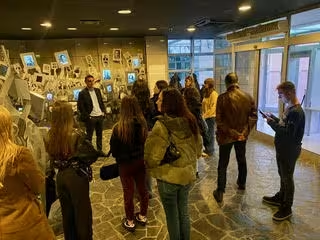
The memory issue is one of the dividing axes between Bulgaria and Macedonia; the memory of the Holocaust is particularly polarising. Nationalisms on both sides of the border, fuelled by pro-Russian interests, hinder the democratic process, Macedonia's EU integration and the stability of the region. The recently established BеCitizen LAB aims to work for reconciliation between the two states, bringing together their people, preserving historical memory, and countering attempts by antidemocratic actors to distort and politicise it. The Holocaust Fund of the Jews from Macedonia is the main institution dealing with the topic. The specific objective of the project is to introduce youth from the two states to the history of the Holocaust through the learning-by-doing method. During a travelling seminar in both states, up to 16 young people will explore key memorial sites. For each site visited, the participants will film a video, which will be uploaded to an interactive online memory map. The story will be told through the eyes of the younger generation, who will demonstrate they can remember the past without making it a conflicting point of nationalist narratives. The direct target group are the participants in the seminar. The indirect target group is the visitors to the interactive map, which will be widely promoted through social networks and traditional media to reach a broader audience. The project is divided into two phases: a travelling seminar and the production of an interactive map with video stories. During both implementation phases, an outreach campaign is foreseen as a horizontal activity to disseminate the project, its aims, and its outcomes. The timeframe for preparation and implementation is twelve months. The project’s tangible outcome will be the interactive map with the videos, guaranteeing its sustainability. With its free access, the map will serve as a learning tool in other contexts, thus ensuring the transfer of good practices.